From 22 queries to 3: replacing a per-user offer lookup with a Querydsl IN clause
When a team leader opened the list of users looking for a team, the API looked up offers for each user in a loop and sent 22 queries. Here's how I folded the offer lookup into a single Querydsl IN clause, stitched the results back on with a Map, and cut it to 3 queries and the response time from 0.337s to 0.039s.
Introduction
Gabojait (‘가보자IT’) is a side project of mine: a service for finding teammates, or a team, to build a side project with. Team leaders can browse a list of users who are looking for a team and send an offer to join to anyone they like.
That list API had an N+1 problem. Showing 20 users took 22 queries. This post is about collapsing that repeated lookup into a single IN clause.
1. N+1 and how this API is built 🧩
N+1 is what happens when you load a list of entities with one query (the 1), then fire one more query per entity (the N) to fetch its associated data. A list of 20 means 21 queries; a list of 100 means 101.
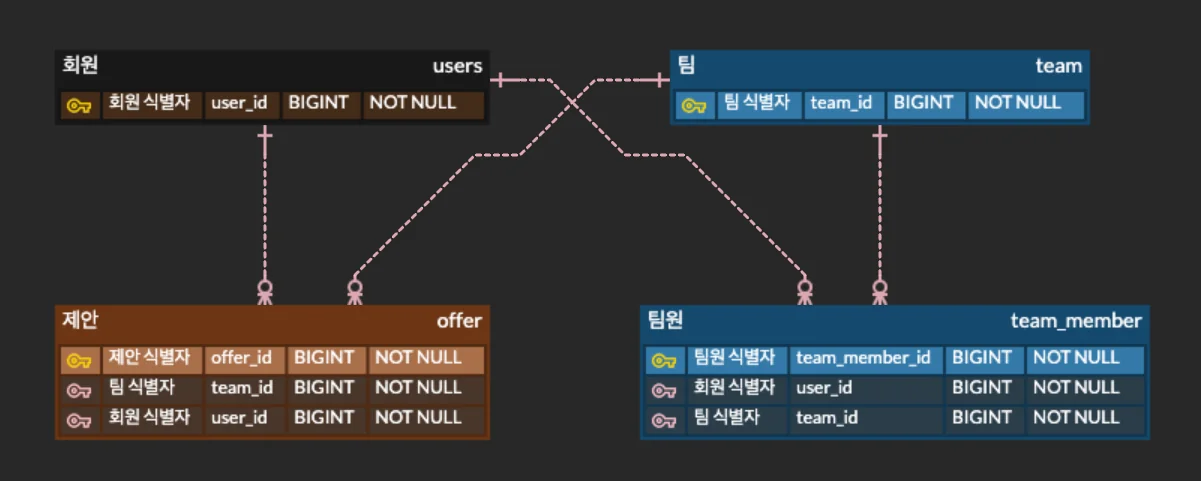
Four tables are involved. There are users (users) and teams (team), linked through team members (team_member). An offer (offer) records which team sent it to which user, via team_id and user_id.
2. Before: one offer lookup per user 🐢
The original logic fetched things one at a time with JpaRepository methods.
- Page through users, filtered by position. (1 query)
- Look up the team the caller leads. (1 query)
- If the caller is a team leader, loop over the users from step 1 and check each one for a pending offer. (N queries)
- If not, return the users from step 1 as they are.
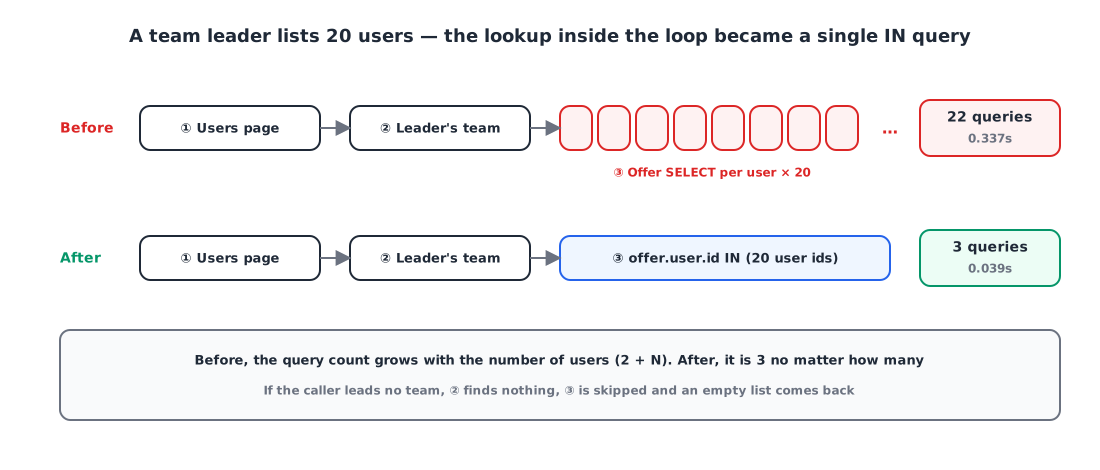
When a team leader requests a page of 20, that’s 1 + 1 + 20, 22 queries in total. The response time was 0.337s.
3. After: offers in a single IN query 🛠️
I rewrote step 3, the one running per user inside the loop, in Querydsl so it takes the list of user IDs and runs one IN query.
1
2
3
4
5
6
7
8
9
10
11
12
13
14
15
16
17
18
19
20
21
22
23
24
public List<Offer> findAllByUserIds(List<Long> userIds, long offerorUserId) {
    Long teamId = queryFactory
            .select(teamMember.team.id)
            .from(teamMember)
            .leftJoin(teamMember.team, team)
            .where(
                    teamMember.user.id.eq(offerorUserId),
                    teamMember.isLeader.isTrue(),
                    teamMember.isQuit.isFalse(),
                    teamMember.team.isDeleted.isFalse()
            ).fetchFirst();

    if (teamId == null) return List.of();

    return queryFactory
            .select(offer)
            .from(offer)
            .where(
                    offer.user.id.in(userIds),
                    offer.team.id.eq(teamId),
                    offer.isAccepted.isNull(),
                    offer.isDeleted.isFalse()
            ).fetch();
}
It first finds the team the caller leads and returns an empty list if there isn’t one, so the non-leader case goes through the same flow without a separate branch. If there is a team, offer.user.id.in(userIds) fetches the offers for every user on the page in one go.
In the service, the offers are grouped by user ID into a Map, then attached to each user.
1
2
3
4
5
6
7
8
9
10
11
12
13
14
15
16
17
18
public Page<ProfileOfferResponse> findPageUser(String username, Position position, long pageFrom, int pageSize) {
    User user = findUser(username);

    Page<User> users = userRepository.findPage(position, pageFrom, pageSize);

    List<Offer> offers = offerRepository.findAllByUserIds(users.stream()
                    .map(User::getId)
                    .collect(Collectors.toList()),
            user.getId());

    Map<Long, List<Offer>> oMap = offers.stream()
            .collect(Collectors.groupingBy(o -> o.getUser().getId()));
    List<ProfileOfferResponse> responses = users.stream()
            .map(u -> new ProfileOfferResponse(u, oMap.getOrDefault(u.getId(), Collections.emptyList())))
            .collect(Collectors.toList());

    return new PageImpl<>(responses, Pageable.ofSize(pageSize), users.getTotalElements());
}
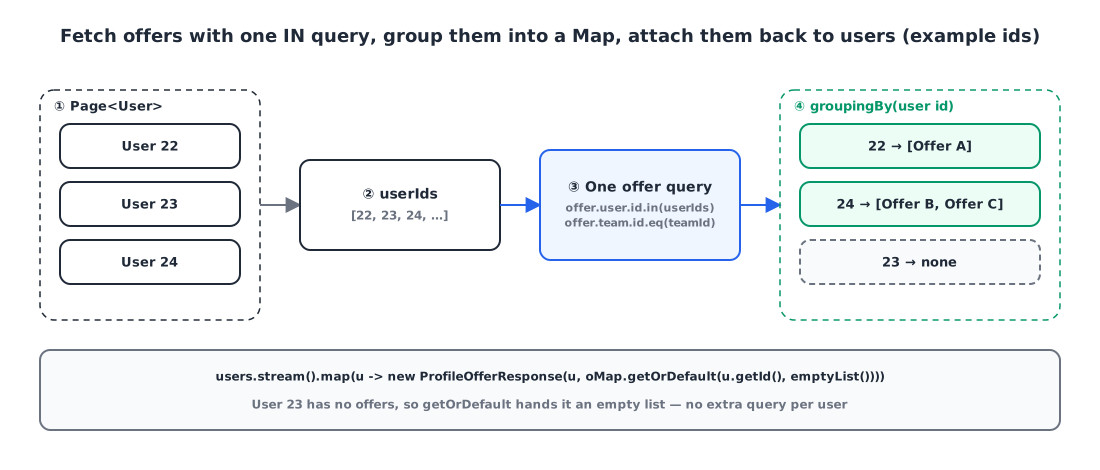
A user with no offers has no key in the Map, so getOrDefault gives them an empty list. No matter how many users there are, nothing gets queried again.
4. Checking the query log 🪵
After the change, three queries go out.
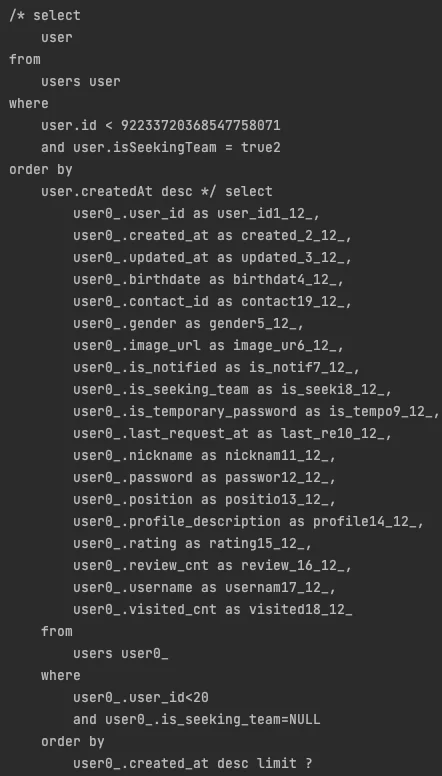
① The user page query. It fetches users looking for a team, cursor-style. I built this one with a Querydsl dynamic query.
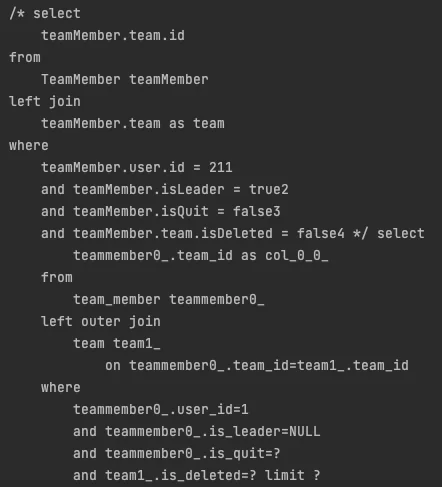
② The leader’s team query. It fetches the ID of one team the caller leads, hasn’t left, and that isn’t deleted.
③ The offer IN query. It puts the IDs of the users on the page into an IN clause and fetches their offers at once.
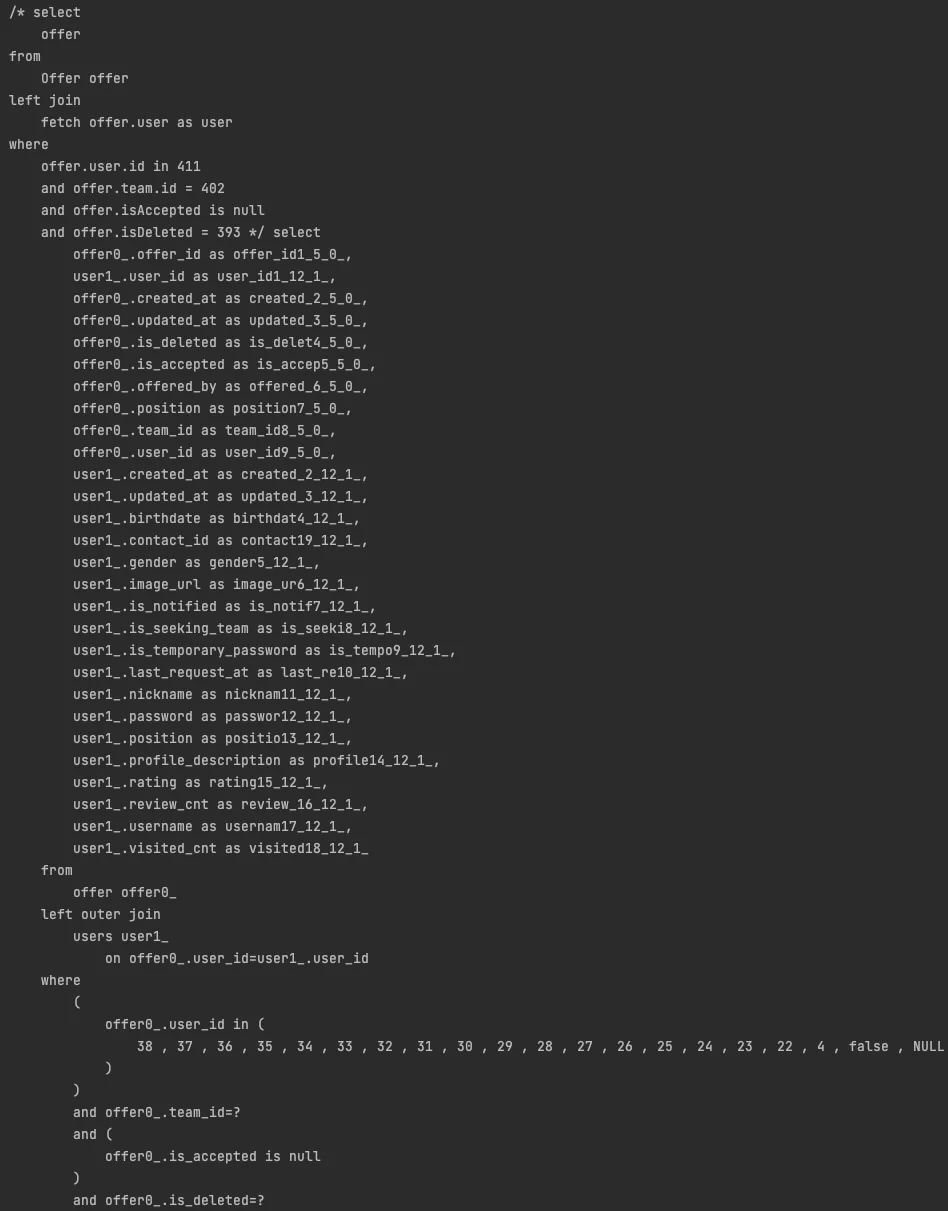
The response time was 0.039s.
5. Results 📊
| Before | After | |
|---|---|---|
| Queries (20 users, team leader) | 22 (2 + N) | 3 |
| Response time | 0.337s | 0.039s (about 8.6x faster) |
Listing 20 users in the same environment went from 0.337s to 0.039s, roughly 8.6x faster. More importantly, the number of queries no longer grows with the page size.
A query inside a loop is an N+1. Collect the IDs first, fetch with one IN clause, and stitch the results back with a
Map.
Wrapping up
- N+1 is a structural problem: the query count grows with the size of the list, so it gets more expensive as the page size goes up.
- Fetch associated data with one IN query on a list of IDs, group it with
groupingBy, and reattach it in memory. - Entities with no associated data get an empty list from
getOrDefault. Don’t query again. - When there’s nothing to look up, as with a non-leader, return an empty list right away and save the query.
Later, during performance testing, I ran into another N+1 that an IN clause couldn’t catch. That story continues in An N+1 that IN clauses couldn’t fix: when @OneToOne lazy loading can’t create a proxy.
References