An N+1 that IN clauses couldn't fix: when @OneToOne lazy loading can't create a proxy
I thought I'd cleared out every N+1 with IN clauses, but a performance test showed one contact query per user again. Why switching @OneToOne to LAZY didn't stop it, how default_batch_fetch_size took the response from 124ms to 54ms, and why I didn't switch to @ManyToOne instead.
Introduction
While refactoring my side project Gabojait (‘가보자IT’) from top to bottom, I removed N+1 problems one by one. Most of them went away with Querydsl IN clauses, which I wrote up in Fixing N+1 with an IN clause.
Then, during performance testing, an N+1 showed up again. In an API I thought I’d fully covered with IN clauses, a query was firing for every user it loaded. This post is about how @OneToOne turned out to be the cause.
1. Users and contacts are one-to-one 🔗
The requirement is “one account per email”. A user never has more than one contact, so I mapped User and Contact with @OneToOne. I suspected the default EAGER would cause trouble later, so I switched it to LAZY from the start.
1
2
3
4
5
6
7
8
9
10
11
12
13
14
15
16
@Getter
@Entity(name = "users")
@NoArgsConstructor(access = AccessLevel.PROTECTED)
public class User extends BaseEntity implements UserDetails {

    @Id
    @GeneratedValue(strategy = GenerationType.IDENTITY)
    @Column(name = "user_id")
    private Long id;

    @OneToOne(fetch = FetchType.LAZY, cascade = CascadeType.REMOVE, orphanRemoval = true)
    @JoinColumn(name = "contact_id", nullable = false)
    private Contact contact;

    // ...
}
It’s LAZY, so as long as nothing touches contact, no query should go out. That assumption was wrong.
2. Where it broke: paging users looking for a team 🔍
The affected API lists users who are looking for a team. The logic has four steps.
- Page through users.
- Fetch those users’ skills in one go with an IN clause on their IDs.
- Fetch the offers already sent to or received by those users in one go, with an IN clause.
- Combine users, skills and offers with
Maps and return them.
1
2
3
4
5
6
7
8
9
10
11
12
13
14
15
16
17
18
19
20
public PageData<List<ProfileOfferResponse>> findPageUser(String username, Position position, long pageFrom, int pageSize) {
    User user = findUser(username);

    Page<User> users = userRepository.findPage(position, pageFrom, pageSize);
    List<Long> userIds = users.stream().map(User::getId).collect(Collectors.toList());

    List<Skill> skills = skillRepository.findAllInFetchUser(userIds);            // IN clause
    List<Offer> offers = offerRepository.findAllInUserIds(userIds, user.getId()); // IN clause

    Map<Long, List<Skill>> sMap = skills.stream().collect(Collectors.groupingBy(s -> s.getUser().getId()));
    Map<Long, List<Offer>> oMap = offers.stream().collect(Collectors.groupingBy(o -> o.getUser().getId()));

    List<ProfileOfferResponse> responses = users.stream()
            .map(u -> new ProfileOfferResponse(u,
                    sMap.getOrDefault(u.getId(), Collections.emptyList()),
                    oMap.getOrDefault(u.getId(), Collections.emptyList())))
            .collect(Collectors.toList());

    return new PageData<>(responses, users.getTotalElements());
}
Every association is fetched once with an IN clause. By design, that’s four queries: count, users, skills, offers.
3. Following the log 🪵
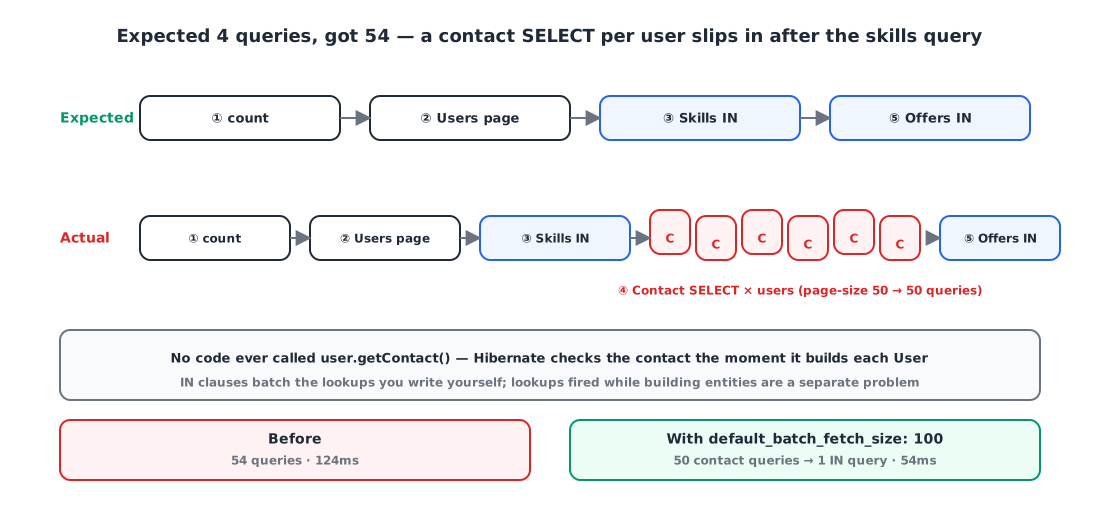
I set the page size to 50 and read the query log in order.
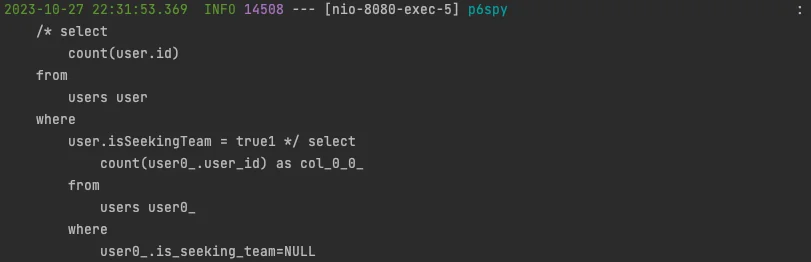
① The user count query. It’s a paged query, so the total comes first.
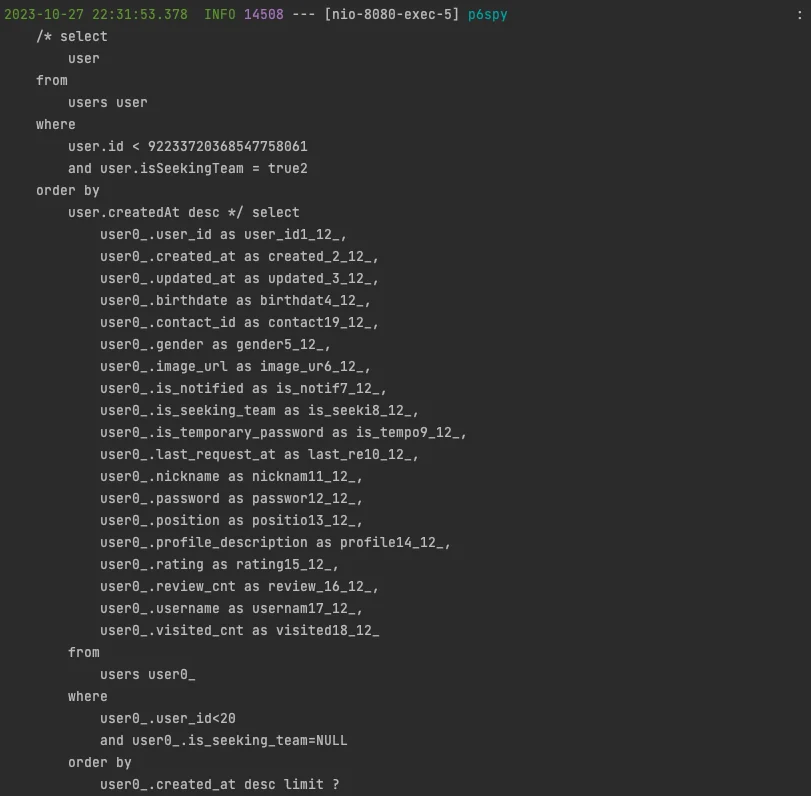
② The user page query. It fetches the users by cursor.
③ The skills IN query. It fetches skills for all loaded users at once by their IDs. So far, so good.
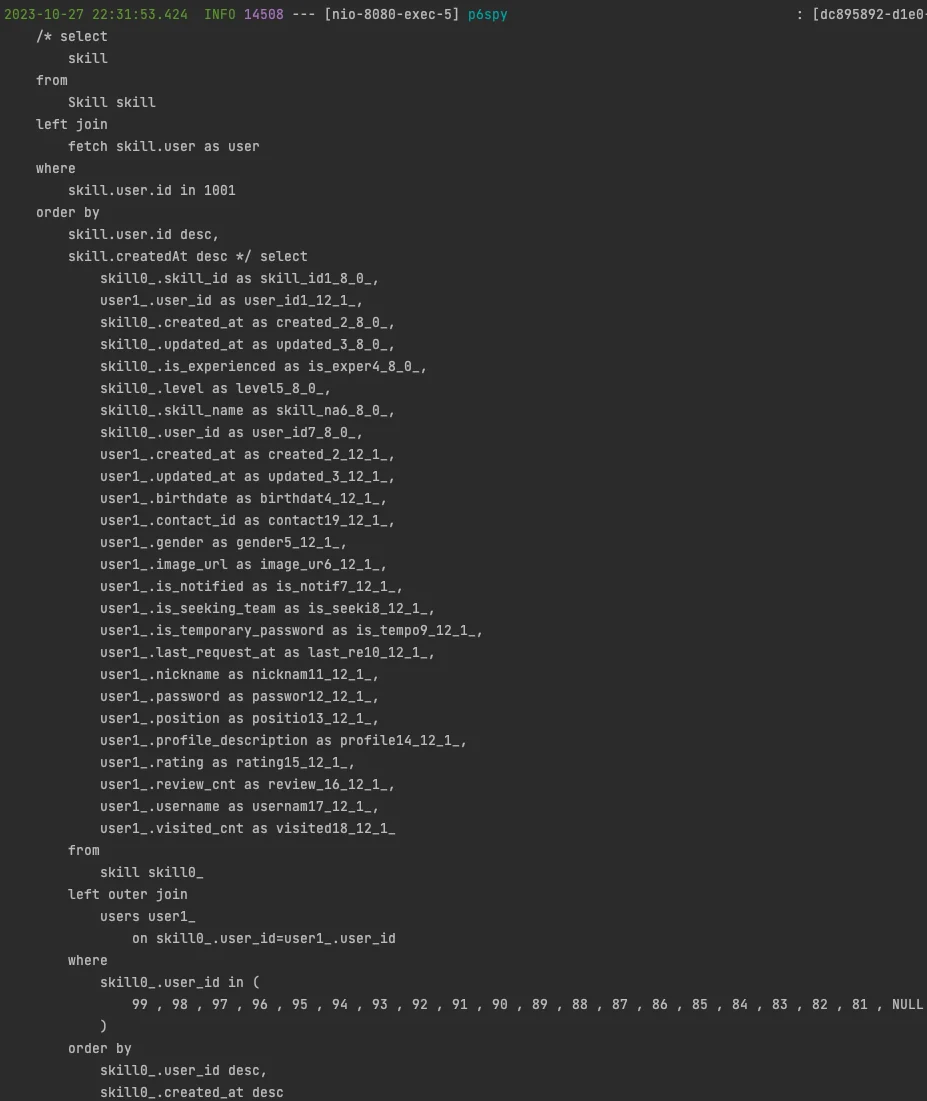
④ One contact query per user. Suddenly a contact SELECT runs for every loaded user, even though no code anywhere reads contact.
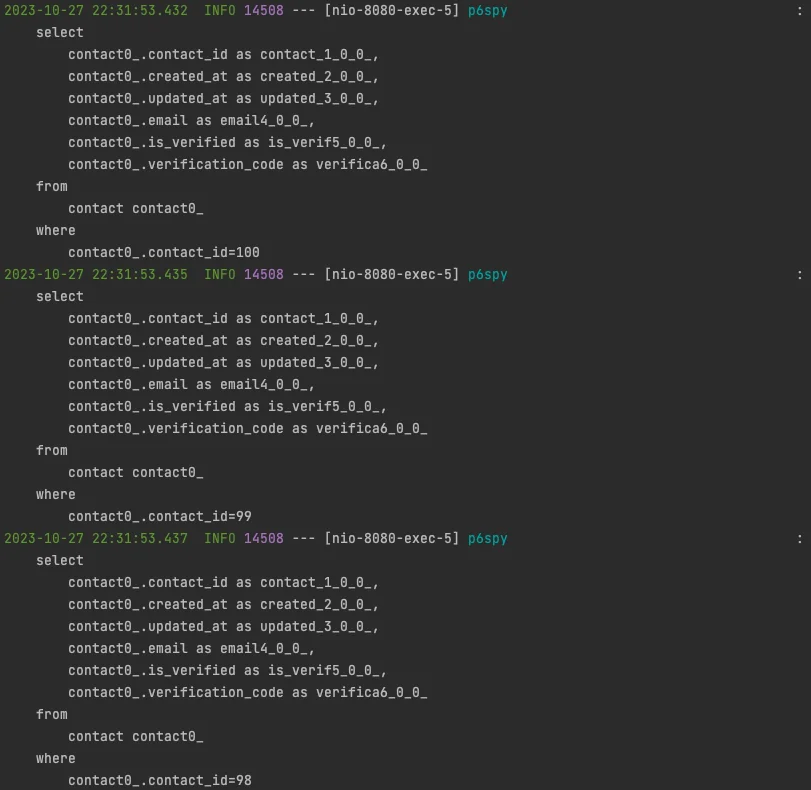
⑤ The offers IN query. Finally, the offers come back in one query.
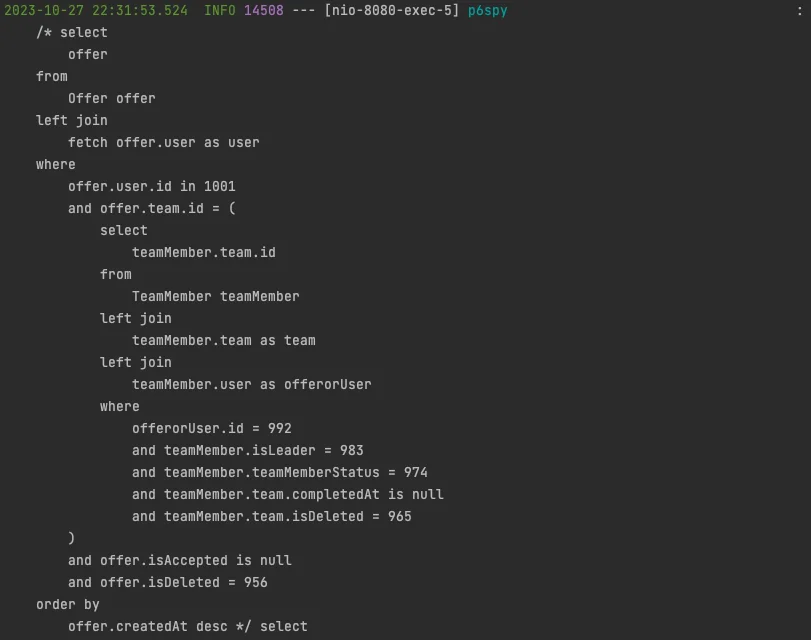
In this state, the response took 124ms.

4. The cause: LAZY doesn’t always mean lazy 🧐
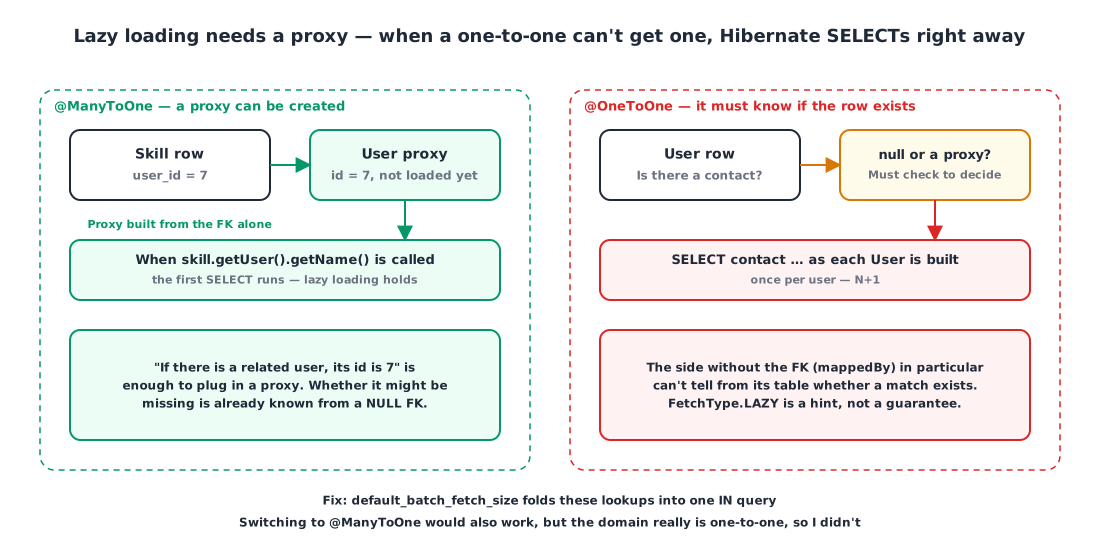
FetchType.LAZY is a hint that says “don’t fetch this now”, not a guarantee. For lazy loading to work, Hibernate has to put a proxy in the association field and only send a query when you actually access it.
The trouble is that with @OneToOne, sometimes it can’t create that proxy. With @ManyToOne, the fact “if there’s a related entity, its id is this” is all it needs to build a proxy. In a one-to-one relationship, though, Hibernate first has to know whether the related entity exists at all, to decide between a proxy and null. The side that doesn’t hold the foreign key (the mappedBy side) in particular can’t tell that from its own table. So Hibernate queries right away to find out. That’s one query per entity it populates: 50 users, 50 contact queries.
In short:
| Relationship | Proxy | Is LAZY respected? |
|---|---|---|
@ManyToOne | Built from the foreign key value alone | Yes |
@OneToOne (side holding the FK) | Usually built | Usually |
@OneToOne (mappedBy side) | Can’t be built without knowing whether a row exists | No, it becomes an immediate query |
Why 600 tests missed it
The project had more than 600 tests, and none of them caught this. There were two reasons.
- The paging tests only ran on small data. With two or three users, two or three contact queries don’t stand out.
- When I read the logs, I only checked that the IN clauses went out. I only looked at the queries I wanted to see.
5. The fix: default_batch_fetch_size 🛠️
The easiest fix is Hibernate’s batch fetching. Instead of firing the same kind of lazy load one at a time, Hibernate gathers them into an IN clause and fetches them at once.
1
2
3
4
5
6
# application.yml
spring:
  jpa:
    properties:
      hibernate:
        default_batch_fetch_size: 100
1
2
# application.properties
spring.jpa.properties.hibernate.default_batch_fetch_size=100
People commonly set it somewhere between 100 and 1000, depending on the server and the data size. This project ran on the AWS free tier, so I went with 100.
With that in place, the per-user contact queries collapsed into a single IN query.
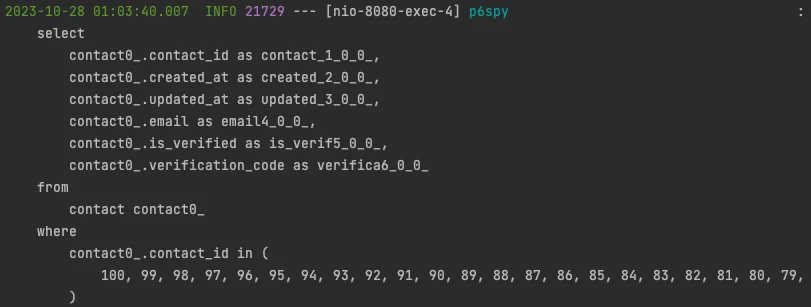
The response time went from 124ms to 54ms.

| Before | After | |
|---|---|---|
| Contact queries (page size 50) | 50 | 1 (IN clause) |
| Response time | 124ms | 54ms (about 2.3x faster) |
6. The alternative: switch to @ManyToOne 🤔
Since the root cause is a property of one-to-one relationships, changing the mapping to @ManyToOne would make the proxy problem disappear entirely. I didn’t go that way.
- A user never has more than one contact. The domain is clearly one-to-one.
- Even when a user verifies a new contact, we just update the existing row. There’s no need for many-to-one.
Rather than change the relationship the domain describes just to save queries, I decided turning on batch fetching with one line of config was the right call.
Wrapping up
FetchType.LAZYis a hint. If Hibernate can’t build a proxy, it fills the field with an immediate query.@OneToOnehas to know whether the related entity exists before it can create a proxy, so lazy loading breaks on the side without the foreign key.- Even when you gather associations with IN clauses, lookups triggered while entities are being populated are a separate problem.
default_batch_fetch_sizebatches those into IN clauses. - Tests on small data won’t show an N+1. Don’t just look for the queries you expect in the log; count all of them.
References