Checking for duplicate emails: findBy vs countBy vs existsBy on 50,000 rows
I'd been writing email duplicate checks with findBy out of habit. On 50,000 rows I logged the SQL that Spring Data JPA's findBy, countBy and existsBy actually generate, got 214ms, 196ms and 166ms, and explain why existsBy is the right fit for a duplicate check.
Introduction
Most services check at sign-up whether a username or email is already taken. I’d always written that check with findByEmail without giving it much thought. It returns an Optional, so isPresent() seemed like all I needed.
But a duplicate check only needs one answer: yes or no. Do we really need to pull the whole row to get it? I ran the three query methods Spring Data JPA offers for this, findBy, countBy and existsBy, under the same conditions and compared the SQL each one actually sends.
1. The setup 🧪
The check runs against a Contact entity that holds an email. The email column has a unique constraint.
1
2
3
4
5
6
7
8
9
@Getter
@Entity
@NoArgsConstructor(access = AccessLevel.PROTECTED)
public class Contact extends BaseEntity {
    // ...
    @Column(nullable = false, unique = true)
    private String email;
    // ...
}
Before testing I inserted 50,000 rows, from tester1@nogamsung.com to tester50000@nogamsung.com, and had all three methods look up tester30000@nogamsung.com.
2. findBy fetches the whole row 📦
1
2
3
public interface ContactRepository extends JpaRepository<Contact, Long> {
    Optional<Contact> findByEmail(String email);
}
1
2
3
4
5
6
7
8
9
10
11
@Test
void findByEmail() {
    // given
    String email = "tester30000@nogamsung.com";

    // when
    Optional<Contact> result = contactRepository.findByEmail(email);

    // then
    assertThat(result).isPresent();
}
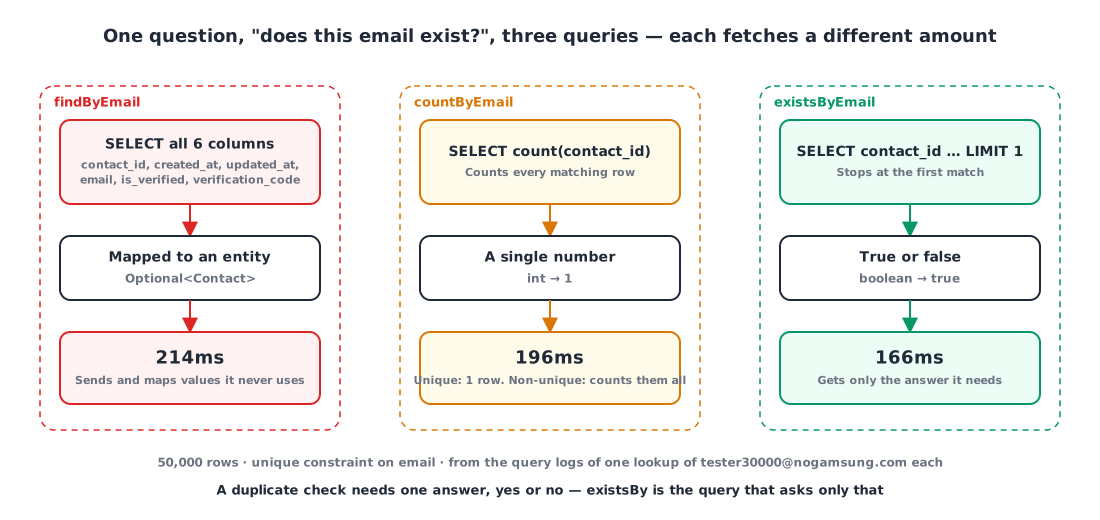
The log shows it SELECTs all six columns of the contact table. Values a duplicate check never touches, like verification_code and created_at, travel over the network, get mapped into an entity and land in the persistence context.
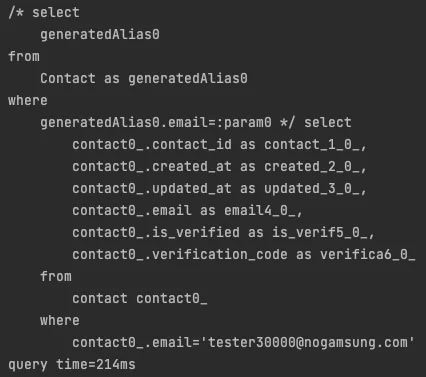
It took 214ms.
3. countBy counts rows 🔢
1
2
3
public interface ContactRepository extends JpaRepository<Contact, Long> {
    int countByEmail(String email);
}
1
2
3
4
5
6
7
8
9
10
11
@Test
void countByEmail() {
    // given
    String email = "tester30000@nogamsung.com";

    // when
    int result = contactRepository.countByEmail(email);

    // then
    assertThat(result).isEqualTo(1);
}
Only count(contact_id) comes back, so less data moves. But count asks how many rows match, which in principle means counting every matching row. Here the unique constraint caps the matches at one, so the cost is small. On a non-unique column, though, you’d only get an answer after counting all the matches, and that’s information a duplicate check doesn’t need.
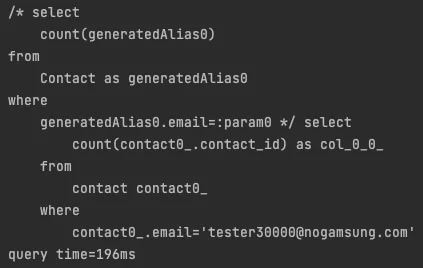
It took 196ms.
4. existsBy stops at the first match ✅
1
2
3
public interface ContactRepository extends JpaRepository<Contact, Long> {
    boolean existsByEmail(String email);
}
1
2
3
4
5
6
7
8
9
10
11
@Test
void existsByEmail() {
    // given
    String email = "tester30000@nogamsung.com";

    // when
    boolean result = contactRepository.existsByEmail(email);

    // then
    assertThat(result).isTrue();
}
Spring Data JPA turns existsBy into a query that selects only contact_id and appends limit 1. It stops as soon as it finds the first row, and Java gets back a single boolean. The shape of the query matches the shape of the question exactly.
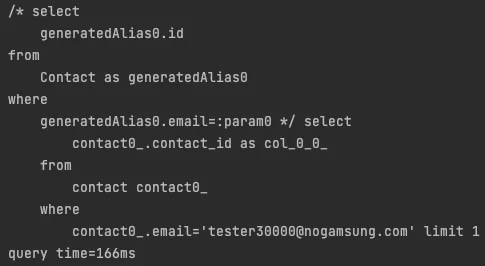
It took 166ms.
5. Comparing the results 📊
| findBy | countBy | existsBy | |
|---|---|---|---|
| What it SELECTs | All 6 columns | count(contact_id) | contact_id + limit 1 |
| Return type | Optional<Contact> | int | boolean |
| When it stops | After fetching every matching row | After counting every matching row | At the first matching row |
| Query time | 214ms | 196ms | 166ms |
existsBy ran about 22% faster than findBy. That said, each method ran only once, so the numbers matter less than the difference in what each query asks and what it gets back. That difference grows with more data, with more columns, and when the column you check isn’t unique.
If the question is “does it exist?”, have the query ask only that. Fetching rows or counting them is a different question.
Wrapping up
- Checking for duplicates with
findBysends columns you won’t use and maps them into an entity. countByasks for a count, so it counts every matching row. On a unique column the difference is small; on a non-unique one it adds up.existsByselects one identifier withlimit 1, stops at the first row and returns aboolean. That’s the right tool for a duplicate check.- When comparing performance, look at the SQL that actually goes out before you look at the numbers.
References