One method per condition is too many: a cursor-paginated dynamic query in Querydsl
Writing one method with the position filter and one without means the number of queries grows with every combination of conditions. Using the fact that Querydsl ignores null conditions in where(), I merged a cursor-paginated query into one, split out the count query, and explain why the cursor key and the sort key have to match.

Introduction
Gabojait (‘가보자IT’), my side project, has a list of users who are looking for a team. At first it only showed everyone. Soon a position filter followed, things like “backend developers only”. Writing one query with the filter and one without, I could see that every new condition would double the number of methods.
This post is about merging those two queries into a single Querydsl dynamic query: SQL whose conditions depend on the input, built at runtime and then sent to the database.
1. Static queries need a method per condition 🧱
Say we paginate users in the users table by cursor. Cursor-based pagination cuts the next page relative to the last value of the previous one, as in “the 10 rows with an id lower than this”.
Example 1: all users.
1
SELECT * FROM users WHERE user_id < 100 ORDER BY created_at DESC LIMIT 10;
Example 2: users whose position is BACKEND.
1
SELECT * FROM users WHERE user_id < 100 AND position = 'BACKEND' ORDER BY created_at DESC LIMIT 10;
With Spring Data JPA derived queries, each condition needs its own method.
1
2
3
4
5
public interface UserRepository extends JpaRepository<User, Long> {
    Page<User> findByIdLessThan(Long id, Pageable pageable);

    Page<User> findByIdLessThanAndPosition(Long id, Position position, Pageable pageable);
}
Querydsl doesn’t change that if the conditions are fixed. Example 1 looks like this:
1
2
3
4
5
6
7
8
9
10
11
12
13
14
15
16
17
18
19
20
21
22
23
24
25
26
27
28
@RequiredArgsConstructor
public class UserRepositoryImpl implements UserCustomRepository {
    private final JPAQueryFactory queryFactory;

    @Override
    public Page<User> findByPage(long pageFrom, int pageSize) {
        Long count = queryFactory.select(user.count())
                .from(user)
                .where(
                        user.isSeekingTeam.isTrue()
                ).fetchOne();

        Pageable pageable = Pageable.ofSize(pageSize);

        if (count == null || count == 0)
            return new PageImpl<>(List.of(), pageable, 0);

        List<User> users = queryFactory.selectFrom(user)
                .where(
                        user.id.lt(pageFrom),
                        user.isSeekingTeam.isTrue()
                ).orderBy(user.createdAt.desc())
                .limit(pageSize)
                .fetch();

        return new PageImpl<>(users, pageable, count);
    }
}
Example 2 differs by a single condition, yet it needs a whole second method.
1
2
3
4
5
6
7
8
9
10
11
12
13
14
15
16
17
18
19
20
21
22
23
@Override
public Page<User> findByPage(Position position, long pageFrom, int pageSize) {
    Long count = queryFactory.select(user.count())
            .from(user)
            .where(
                    user.position.eq(position)
            ).fetchOne();

    Pageable pageable = Pageable.ofSize(pageSize);

    if (count == null || count == 0)
        return new PageImpl<>(List.of(), pageable, 0);

    List<User> users = queryFactory.selectFrom(user)
            .where(
                    user.id.lt(pageFrom),
                    user.position.eq(position)
            ).orderBy(user.createdAt.desc())
            .limit(pageSize)
            .fetch();

    return new PageImpl<>(users, pageable, count);
}
Two filters make four combinations; three make eight. That doesn’t scale.
2. Picking a tool for dynamic queries 🧰
Derived queries bake the conditions into the method name, so you can’t add or drop one at runtime. There are several ways to build dynamic queries instead.
| Approach | Combining conditions | When errors surface |
|---|---|---|
| Derived query methods | One method per combination | At application startup |
| Concatenating JPQL strings | Possible | At runtime |
| JPA Criteria / Specification | Possible | At compile time with the metamodel, but the code is verbose |
| Querydsl | Possible | At compile time, and it reads much like SQL |
I went with Querydsl: it catches errors at compile time and the code reads like SQL.
3. Return null and the condition disappears 🪄
The key is that Querydsl’s where() ignores null conditions. If the method that builds a condition returns null in some cases, one query produces two different SQL statements.
1
2
3
4
5
6
7
8
9
10
11
12
13
14
15
16
17
18
19
20
21
22
23
24
25
26
27
28
29
30
31
32
@RequiredArgsConstructor
public class UserRepositoryImpl implements UserCustomRepository {
    private final JPAQueryFactory queryFactory;

    @Override
    public Page<User> findPage(Position position, long pageFrom, int pageSize) {
        Long count = queryFactory.select(user.count())
                .from(user)
                .where(
                        positionEq(position)
                ).fetchOne();

        Pageable pageable = Pageable.ofSize(pageSize);

        if (count == null || count == 0)
            return new PageImpl<>(List.of(), pageable, 0);

        List<User> users = queryFactory.selectFrom(user)
                .where(
                        user.id.lt(pageFrom),
                        positionEq(position)
                ).orderBy(user.createdAt.desc())
                .limit(pageSize)
                .fetch();

        return new PageImpl<>(users, pageable, count);
    }

    private Predicate positionEq(Position position) {
        return position != Position.NONE ? user.position.eq(position) : null;
    }
}
positionEq() returns null when the position is NONE and user.position.eq(position) otherwise. Since where(a, b, null) is the same as where(a, b), NONE sends SQL without a position condition and BACKEND sends SQL with one.
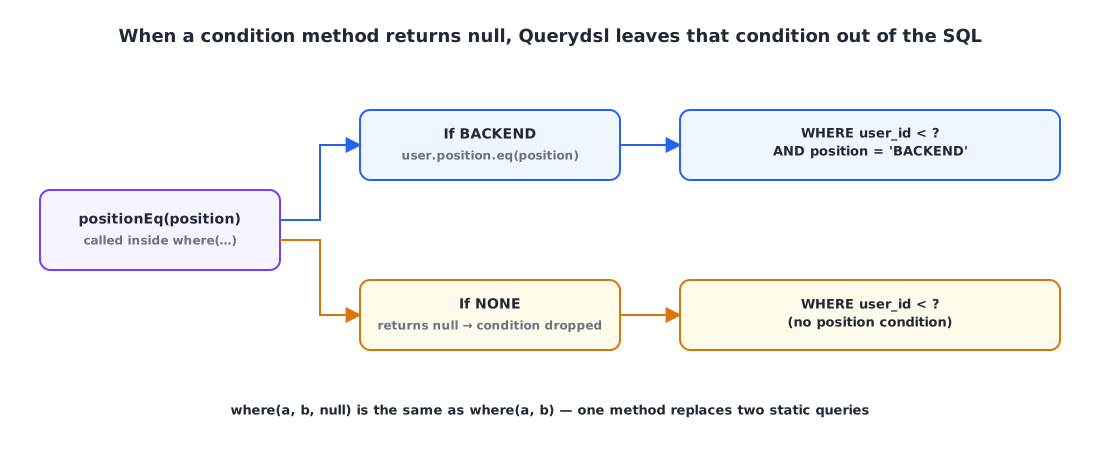
A new filter just means another condition method dropped into where(). You don’t need one query per combination.
4. How the cursor pagination flows 🔁
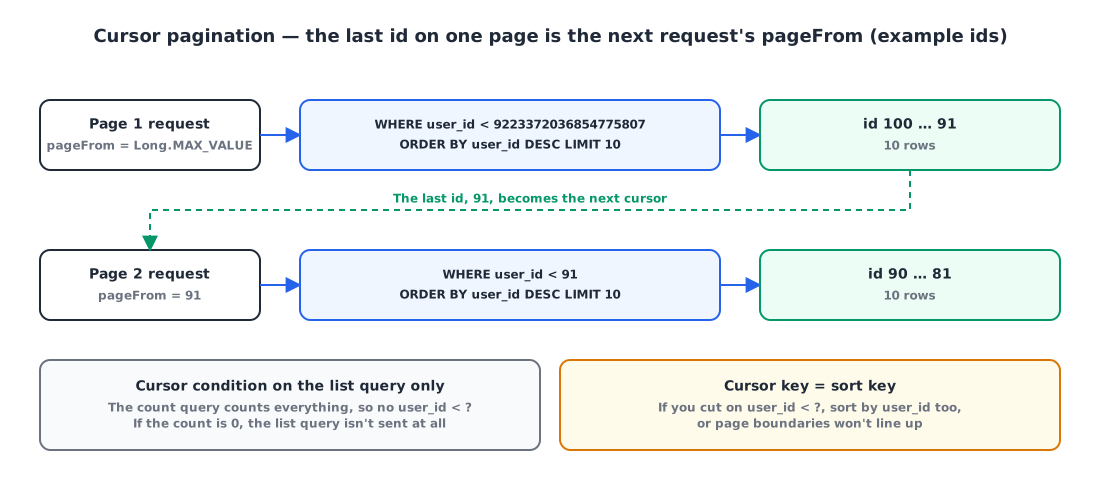
Inside that one method, two queries go out.
- The count query counts every row that matches. Since it’s a total, it leaves out the cursor condition (
user.id.lt(pageFrom)). - If the count is 0, the list query is never sent and an empty page comes back immediately.
- The list query applies the cursor condition along with the filters and uses
limitto fetch just one page.
The next page is requested by passing the last id of the previous page as pageFrom. The first page has no id to start from, so in this project I passed Long.MAX_VALUE.
Compared with offset pagination:
Offset (OFFSET n LIMIT 10) | Cursor (WHERE id < ? LIMIT 10) | |
|---|---|---|
| What defines the next page | How many rows to skip | The last value of the previous page |
| Cost of later pages | Reads the skipped rows and throws them away | Reads from the index starting at that value |
| Rows added while paging | Can cause duplicates or gaps | Only reads past the cursor, so less affected |
| Jumping to an arbitrary page | Easy | Hard |
5. Watch out: match the cursor key and the sort key ⚠️
The code above cuts the cursor on user.id but sorts on created_at. As long as user ids come from IDENTITY and increase in creation order, the two orders agree and nothing shows. But the moment they diverge, say because someone sets or edits created_at separately, users go missing or show up twice at page boundaries.
The safe choice is to cursor and sort on the same column.
1
2
3
4
5
6
7
List<User> users = queryFactory.selectFrom(user)
        .where(
                user.id.lt(pageFrom),
                positionEq(position)
        ).orderBy(user.id.desc())
        .limit(pageSize)
        .fetch();
The column in the cursor condition and the
ORDER BYcolumn must be the same. Otherwise “everything after this value” stops meaning anything.
Wrapping up
- Derived queries and fixed queries need a new method for every combination of conditions.
- Querydsl’s
where()ignoresnullconditions. Let condition methods returnnullwhen they don’t apply, and one query produces several SQL statements. - Keep the cursor condition out of the count query, and skip the list query when the count is 0.
- Use the same column for the cursor key and the sort key.
This findPage also served as the first query, the one that loads the users, in the post where I fixed an N+1 with an IN clause.
References